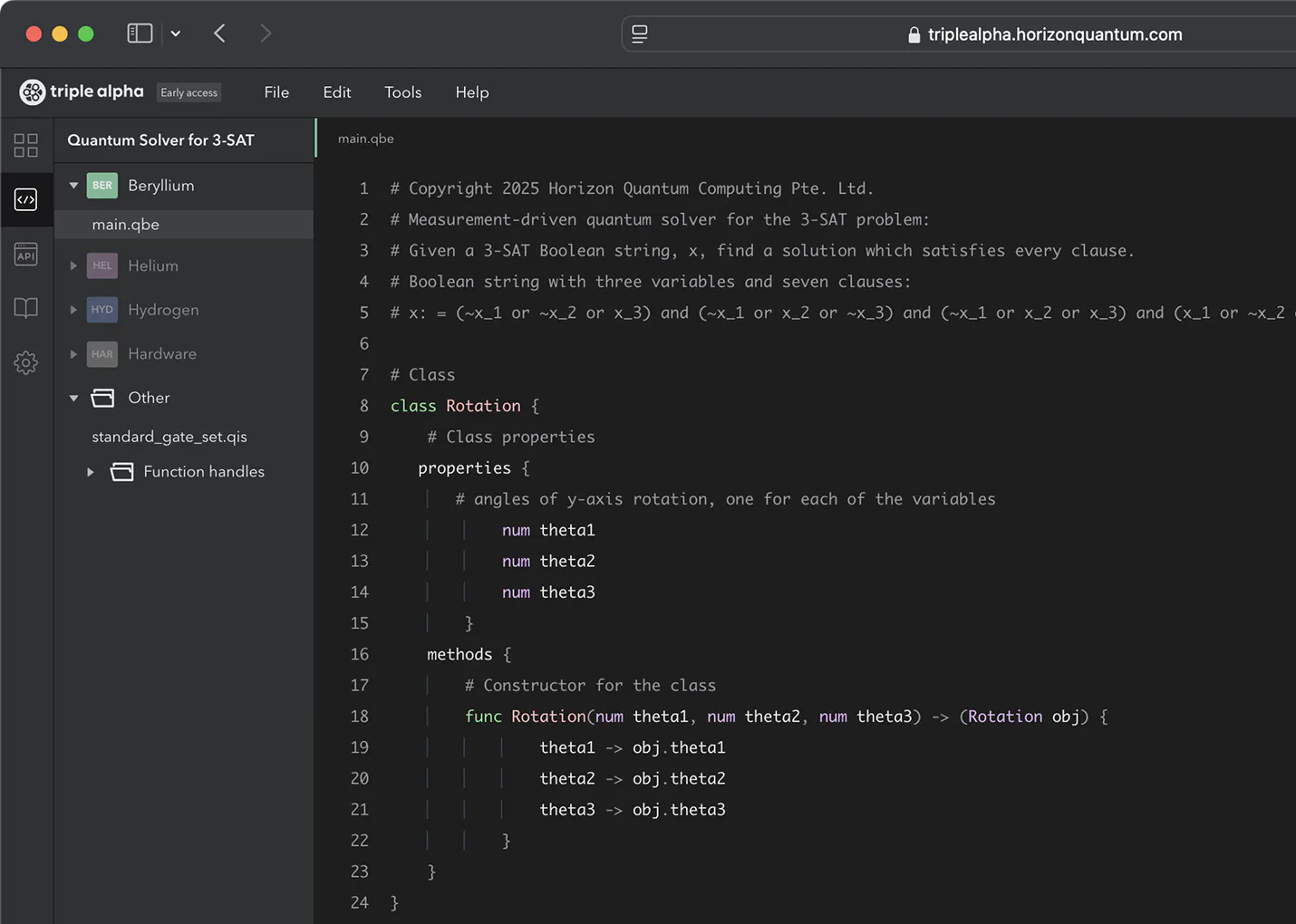
Redefining the Boundaries of What's Possible in Quantum Computing
Horizon Quantum’s development infrastructure lets developers pick the entry point that best fits their needs—whether writing high-level applications, coding in an assembly-like language, or programming directly at the hardware level.

Abstract away the complexities of quantum physics
Triple Alpha, our integrated development environment, has advanced capabilities—such as dynamic memory management and circuit synthesis from classical code—that enable a higher level of abstraction than most current quantum programming approaches, while still allowing developers to engage with low-level control when needed.
High-level programming
Optimizing compiler
Portable low-level intermediate representation (IR)
Instruction set translation
Scheduling of pulse-level operations
Generation of system-specific code
Resource planning / estimation

From high-level logic to hardware-ready code
Triple Alpha simplifies quantum programming by letting developers work at different levels of abstraction—from higher-level algorithm design to low-level hardware manipulation. This flexibility means that developers can focus on algorithm design and error correction rather than circuit engineering.
Triple Alpha’s optimizing compiler translates Beryllium, our object-oriented programming language, and Helium, our BASIC-like programming language, into Hydrogen, our lower-level assembly-like language designed for quantum systems.
By making C/C++ functions available as callable subroutines within Helium, Triple Alpha eliminates the need to manually design reversible circuits for classical components of a quantum algorithm.

Hardware-targeted compilation
Hydrogen code can be compiled further to target specific quantum devices. It represents control flow—such as if statements, loops, and conditional logic—through code blocks and conditional jumps.
Triple Alpha’s optimization engine translates code written in a user-defined instruction set into the native instruction set of a target processor, respecting coupling constraints and ensuring efficient, accurate execution.
Using a hybrid classical–quantum approach, Triple Alpha’s compiler and execution infrastructure can emulate advanced control structures even on hardware that lacks native dynamic control.
Triple Alpha quantifies the resources required to run programs—such as gate count and qubit usage—giving developers insight into performance trade-offs before deployment.

Program optimisation
Once a program is in a low-level form, Triple Alpha’s optimization engine applies peephole optimization and other methods to simplify logic and remove redundant operations, refining circuits and optimizing gate sequences.
Triple Alpha’s optimization engine balances performance trade-offs to improve implementation efficiency, tuning the program for the target processor’s topology and instruction set.
Triple Alpha produces efficient code in formats readable by different systems, such as QUA, OpenPulse, and QASM.

Portable performance across hardware platforms
Quantum applications compiled in Triple Alpha are automatically optimized for each processor’s instruction set and connectivity.
Using Triple Alpha, developers can create quantum programs that run across multiple hardware platforms without rewriting.
As the hardware landscape evolves, developers can maintain and reuse their code, future-proofing their quantum software.
Hardware-level control
By supporting hardware-level coding, Triple Alpha allows users to target specific devices with fine-grained control over their programs.
Triple Alpha gives developers access to pulse-level control, allowing them to directly manipulate the signals sent from control systems to the quantum processor.
Triple Alpha lets programmers write in a hardware provider's framework of choice, such as OpenQASM or Quil, and customize their code to the target processor's connectivity constraints while still taking advantage of Horizon Quantum's deployment infrastructure.
Next-generation quantum software development
In addition to Triple Alpha’s existing capabilities, Horizon Quantum is also exploring techniques for automatically constructing quantum-accelerated algorithms from classical code. These methods go beyond merely translating instructions into a quantum-compatible form: they generate implementations that exploit quantum speedups where possible. Triple Alpha is being designed to bridge the classical and quantum paradigms—and to redefine the boundaries of what’s possible in quantum computing.